
Transmission infrastructure is one of the least visible—yet most important—components of Karnataka’s growing power system. From renewable-energy-rich districts in North Karnataka to major consumption centres such as Bengaluru and Mysuru, electricity must travel through carefully planned high-voltage corridors before it reaches distribution networks.
When a transmission tower is proposed on agricultural land, the first question from a landowner is often straightforward: “Can the tower be shifted a few metres so that it does not fall on my land?”
From an engineering perspective, the answer is rarely simple. A transmission tower is just one component of a much larger system, and its location is strictly determined relative to the entire route. What appears to be a small adjustment in one spot can trigger significant consequences for towers, conductors and safety clearances along the line.
A route is designed, not merely selected
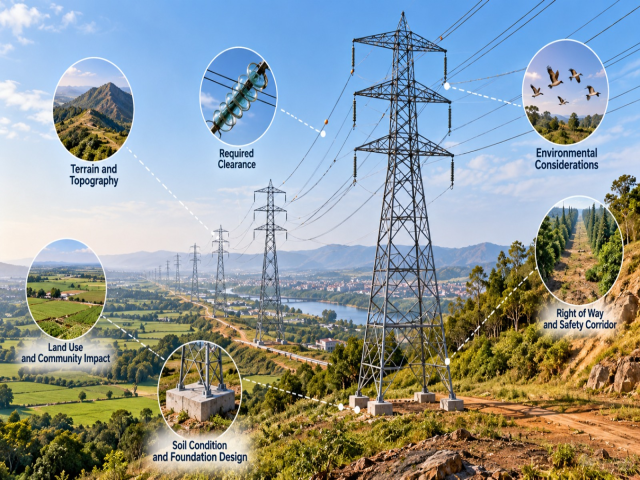
The alignment of a transmission line follows a rigorous technical assessment. Engineers study the terrain and conduct extensive surveys to identify the most suitable path. Settlements, roads, railway lines, forests, water bodies, existing infrastructure and statutory safety clearances are all carefully evaluated.
The objective is to establish an alignment that is technically sound, safe and easily maintained over its operational lifespan. Tower locations are never selected out of convenience or as isolated points on a map, they are the outcome of a comprehensive engineering strategy.
Why moving one tower affects others
Transmission towers operate as part of a continuous structural system. Conductors are suspended between consecutive towers, with sag, tension, span length and ground clearance precisely calculated.
If a single tower is moved, the length and geometry of the adjacent spans change immediately. This alters conductor clearances and structural loads, often requiring adjustments to neighbouring towers. What begins as a request to move one tower can easily force a complete redesign of an entire line section.
Safety determines what is technically possible
High-voltage transmission infrastructure requires strict compliance with statutory safety standards. Safety clearances from buildings, roads and other structures must be always maintained. At the same time, tower foundations are engineered around specific soil conditions, structural loads, and wind forces. A shift that looks minor on the ground can severely impact structural stability, conductor clearance and overall grid reliability.
Landowners can raise legitimate concerns
Engineering constraints do not mean that concerns raised by farmers and landowners are ignored. Representations regarding proposed tower locations can be submitted to the competent authorities. Where an alternative alignment is technically feasible and does not compromise safety, statutory requirements or the integrity of the transmission system, it can be reviewed as per the applicable process.
Courts have also dealt with disputes concerning transmission infrastructure, balancing individual property concerns against the public interest of reliable power delivery. While the availability of a safe, viable alternative is always considered, relocation cannot be granted simply due to personal preference.
The bigger picture matters
Understanding the engineering logic behind transmission corridors provides crucial context for landowners when a tower is proposed on their land. The visible structure in a field is part of an interconnected network built to transport electricity safely over vast distances.
A tower’s final location reflects precise calculations, terrain analysis, statutory compliance and safety protocols. Because no transmission tower stands in isolation, access to clear and accurate information helps landowners navigate the process, raise concerns through proper channels and make informed decisions.

