
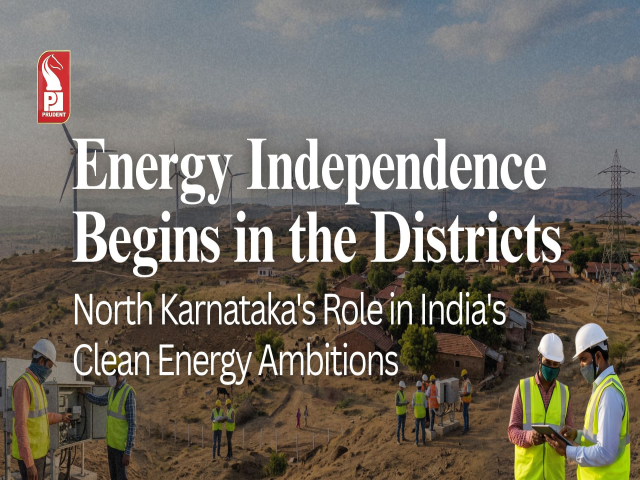
India's pursuit of energy independence will not be decided only in ministries, boardrooms, or international climate conferences. It will be built in districts such as Gadag, Dharwad, Vijayanagara, Koppal, Bagalkot and Vijayapura, where wind corridors, available land, transmission planning and local enterprise converge. North Karnataka already has a credible claim to be one of the country's most important clean-energy regions. The task now is to ensure that this opportunity becomes durable local prosperity rather than merely another extractive infrastructure story.
Karnataka is among India's leading renewable-energy states. As of June 2026, Karnataka had about 8,896 MW of installed wind capacity, contributing roughly 15.5% of India’s total installed wind capacity of 57,443 MW. Gadag, Vijayapura and Chitradurga are identified as the state's leading wind-energy districts. Nationally, India has set a target of 500 GW of non-fossil capacity by 2030 and crossed 300 GW in July 2026. These national numbers matter because they translate into investment, power infrastructure and employment in places like North Karnataka.
A natural wind corridor
The Deccan plateau gives Gadag and neighbouring districts steady wind conditions, relatively open terrain and proximity to existing power infrastructure. Karnataka's wind resources are spread across Davanagere, Chitradurga, Ballari, Vijayapura, Koppal, Gadag, Belagavi and Raichur, with Chitradurga, Davanagere, Koppal and Gadag regarded as especially promising for future capacity. The state has also set a target of adding 6.1 GW of wind capacity by 2030, with KPTCL working to identify sites and ensure nearby substations. For North Karnataka, this creates a rare alignment: strong resource quality, established developers, growing grid attention and a policy environment that recognises wind as central to the state's energy future.
From imported fuel to domestic capacity
Energy independence is ultimately about reducing exposure to volatile imported fuels and building domestic capacity that generates value within India. Every megawatt-hour produced by wind displaces fossil generation and reduces the foreign-exchange pressure associated with imported coal, oil and gas. India's clean-energy transition is therefore not only an environmental programme; it is an economic-security strategy.
Wind energy is particularly valuable because it complements solar. Solar output peaks during the day, while wind often performs better in the evening and monsoon months in many parts of peninsular India. A balanced portfolio of wind, solar, storage and grid upgrades can provide more reliable clean power than either source alone. Hybrid projects, including wind-solar systems with battery storage, are already part of India's renewable pipeline. Gadag and Koppal, for instance, have been associated with a combined project involving solar, wind and a 150 MWh battery-energy storage system.
For a country seeking to industrialise while managing energy costs, this matters. Stable clean electricity can support agro-processing, cold storage, small manufacturing, irrigation efficiency and digital services in district towns. It can also make Karnataka's industrial growth less dependent on distant fuel supply chains.
Farmers must be partners
The most important test for North Karnataka's renewable future is whether farmers and village communities benefit fairly. Wind projects use limited land per turbine, but access roads, transmission lines and construction activity can still affect agriculture, grazing routes and local expectations. Past experience in Gadag has shown the risks of opaque land transactions and inadequate consultation, with reports of farmers losing fertile land or entering poorly understood lease arrangements.
Responsible development requires transparent, long-term land leases; fair and periodically indexed payments; clear compensation for crop or access impacts; local hiring targets; and grievance-redress mechanisms that actually function. Farmers should not be treated merely as land suppliers. They should be informed stakeholders, with legal support, collective bargaining options and a share in the long-term value created by projects on their land.
A practical model would combine lease income with community benefit funds for schools, primary healthcare, water conservation, skill centres and rural roads. Developers, district administrations and panchayats should jointly publish local employment and procurement plans. This would make renewable energy socially legitimate, not just commercially viable.
Skills for the next decade
North Karnataka's young population can gain from the clean-energy economy if training is planned early. Industrial training institutes and polytechnics in Gadag, Dharwad, Koppal and Vijayanagara should offer short-term certification in turbine maintenance, electrical safety, high-voltage operations, drone-based inspection, SCADA systems, battery storage and environmental compliance.
The demand is likely to grow. Karnataka's wind potential has been estimated at 124.15 GW at 120 metres and 169.3 GW at 150 metres, while the state's installed renewable capacity was about 23 GW in early 2025. Even if only a fraction of the technical potential is developed, the need for trained technicians, grid professionals and local service enterprises will expand substantially.
A regional compact
North Karnataka should not be asked simply to host turbines. It should become a clean-energy manufacturing, services and skills region. The state and Centre should prioritise transmission upgrades, storage deployment, faster grid connectivity, transparent land policy and local-content opportunities. District administrations should maintain land records, consult communities early and ensure that project benefits are measurable.
India's 500 GW target is a national goal, but its credibility will be built district by district. If Gadag, Dharwad, Vijayanagara and surrounding regions develop wind power with fairness, skill and long-term local benefit, they will do more than generate electricity. They will help power an independent India while giving their own young people a future rooted in their own land.

